
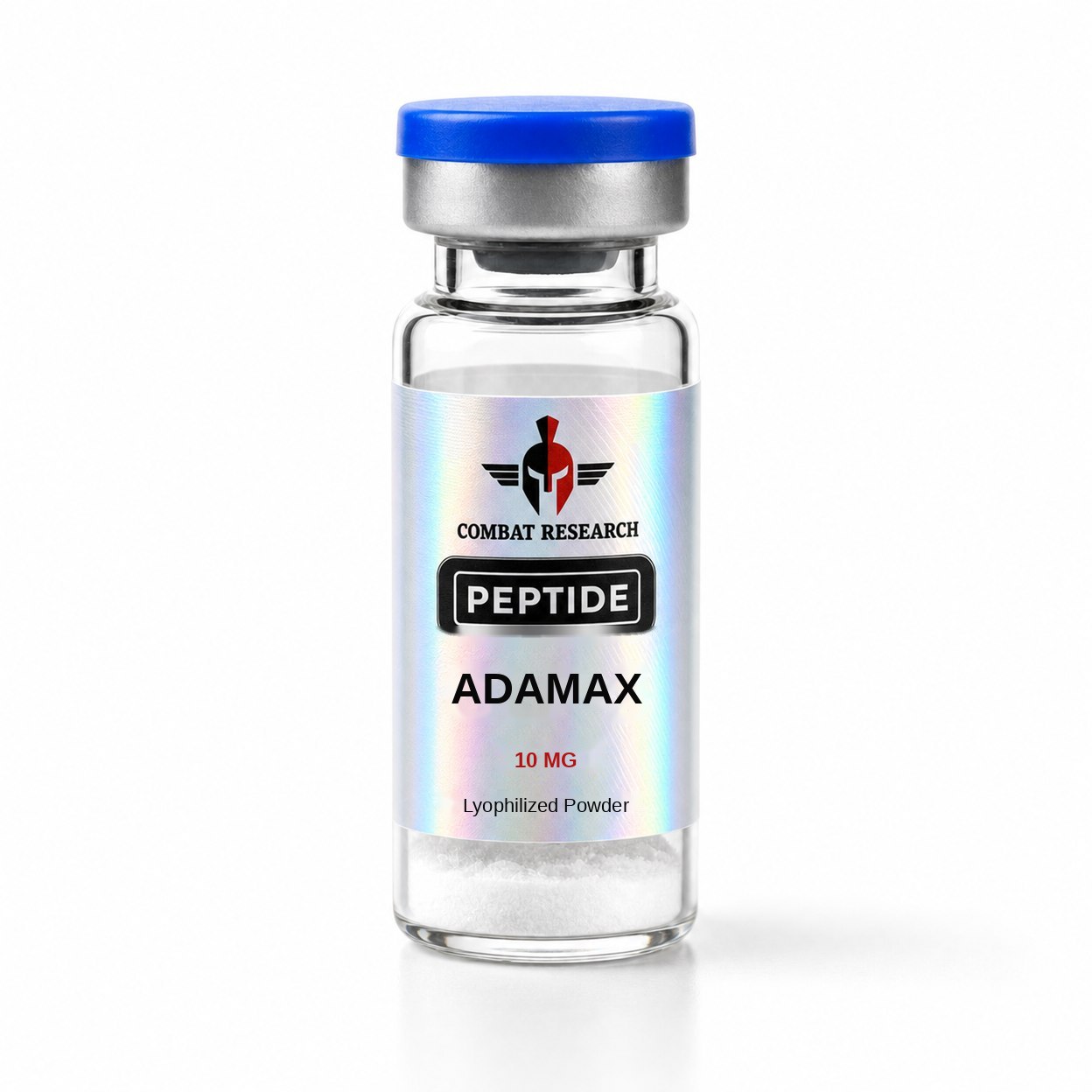
Adamantane-modified N-Acetyl-Semax research peptide (Ac-MEHFPGP + adamantane scaffold). Enhanced blood-brain barrier penetration vs standard Semax variants. BDNF upregulation, TrkB receptor modulation, neuroprotection research. 5 mg lyophilized. ≥99% HPLC purity. Ships from USA. Research use only.
$49.99
40 in stock
Adamax is an advanced synthetic peptide research compound derived from N-Acetyl-Semax — itself a stabilized analog of Semax, the synthetic heptapeptide (Met-Glu-His-Phe-Pro-Gly-Pro; MEHFPGP) originally developed from the ACTH(4-10) fragment at the Institute of Molecular Genetics, Moscow. The defining structural feature of Adamax is the addition of an adamantane moiety, a cage-like polycyclic hydrocarbon scaffold (C10H16) that dramatically increases lipophilicity and blood-brain barrier (BBB) penetration relative to parent Semax sequences. Research applications center on BDNF upregulation, TrkB receptor modulation, and broad neuroprotective mechanisms. Supplied as 5 mg lyophilized peptide per vial.
| Property | Value |
|---|---|
| Common Name | Adamax |
| Chemical Basis | N-Acetyl-Semax with adamantane modification |
| Base Peptide | Semax (MEHFPGP; ACTH 4-7 + Pro-Gly-Pro) |
| Semax CAS | 80714-61-0 |
| Peptide Sequence | Ac-Met-Glu-His-Phe-Pro-Gly-Pro [+ adamantane] |
| Molecular Class | Neuropeptide analog / adamantane conjugate |
| Key Targets | TrkB (NTRK2), BDNF upregulation, MC4R (melanocortin) |
| BBB Enhancement | Adamantane cage increases logP and passive CNS diffusion |
| Quantity | 5 mg lyophilized per vial |
| Purity | ≥99% HPLC — CoA available per batch |
| Reconstitution | Sterile or bacteriostatic water |
| Storage | Lyophilized: cool dry place. Reconstituted: 2–8°C, use within 30 days |
Semax (MEHFPGP) is a synthetic 7-amino-acid peptide derived from the adrenocorticotropin hormone (ACTH) fragment 4-7, extended with a Pro-Gly-Pro C-terminal sequence that resists enzymatic degradation by brain peptidases. It was developed in Russia in the 1980s–1990s as a nootropic research tool, where it demonstrated upregulation of BDNF and NGF (nerve growth factor) mRNA in the rodent hippocampus, activation of serotonergic and dopaminergic systems, and a neuroprotective profile in ischemia models. Semax and its analogs have been extensively studied in Russian clinical and preclinical literature but remain research-stage compounds outside Russia.
The N-acetyl group (CH3CO–) is added to the N-terminus of the Semax heptapeptide, replacing the free amino group. This modification:
The adamantane scaffold (tricyclo[3.3.1.13,7]decane; C10H16) is a rigid, cage-like polycyclic hydrocarbon with exceptional metabolic stability and well-characterized CNS-penetrating properties. Adamantane-based drugs and prodrugs appear throughout CNS pharmacology: amantadine (antiviral/antiparkinsonian), memantine (NMDA antagonist, Alzheimer’s), rimantadine, and multiple experimental drug-delivery conjugates all leverage the adamantane scaffold’s ability to increase logP (lipophilicity) and promote passive diffusion across the blood-brain barrier’s lipid bilayer.
In Adamax, the adamantane moiety is conjugated to the N-Acetyl-Semax backbone to increase the overall lipophilicity of the peptide conjugate, facilitating enhanced transcellular diffusion across brain endothelial cells relative to more hydrophilic semax variants. This engineering approach addresses the primary limitation of peptide-based CNS research tools: native peptides are generally hydrophilic and cross the BBB poorly, limiting CNS bioavailability after systemic delivery.
The primary reported molecular target of Semax and its advanced analogs is the BDNF–TrkB axis. Semax administration has been shown to upregulate hippocampal and cortical expression of Bdnf mRNA and protein, leading to downstream activation of the TrkB (NTRK2) receptor — the cognate high-affinity BDNF receptor. TrkB activation initiates:
Adamax’s enhanced BBB penetration is hypothesized to produce greater CNS BDNF upregulation relative to parent Semax by increasing the fraction of the conjugate reaching central neural tissue. BDNF/TrkB signaling is a focal point of neuroplasticity, depression, memory consolidation, and neuroprotection research.
| Compound | Sequence / Modification | BBB Penetration | Stability | Primary Research Focus |
|---|---|---|---|---|
| Semax | MEHFPGP (free N-terminus) | Moderate (nasal delivery) | Low systemic | Nootropic, BDNF, stroke model |
| N-Acetyl-Semax | Ac-MEHFPGP | Moderate | Improved N-terminal stability | Nootropic, BDNF enhancement |
| Semax Amidate | MEHFPGP-NH2 | Moderate | Improved C-terminal stability | Extended-activity Semax variant |
| Adamax | Ac-MEHFPGP + adamantane | Enhanced (lipophilic) | High (dual stabilization) | CNS delivery, BDNF/TrkB, neuroprotection |
Adamax is a next-generation synthetic peptide research compound built on the N-Acetyl-Semax scaffold (Ac-MEHFPGP – an acetylated version of the heptapeptide Semax, derived from the ACTH(4-7) sequence). Its defining modification is the addition of an adamantane moiety – a cage-like polycyclic hydrocarbon (C10H16) that increases lipophilicity and enhances passive diffusion across the blood-brain barrier. Standard Semax is hydrophilic and crosses the BBB primarily via nasal delivery routes. Adamax’s adamantane conjugation is designed to improve CNS bioavailability after systemic delivery in research models, enabling investigation of BDNF upregulation and TrkB signaling at greater central peptide concentrations.
Adamantane (tricyclodecane, C10H16) is a rigid, cage-like polycyclic scaffold widely used in CNS pharmacology to increase drug lipophilicity (logP) and BBB penetration. Marketed CNS drugs leveraging adamantane include amantadine (antiviral/antiparkinsonian), memantine (NMDA antagonist for Alzheimer’s disease), and rimantadine. In Adamax, the adamantane moiety raises the overall lipophilicity of the N-Acetyl-Semax conjugate, enabling enhanced transcellular diffusion across brain endothelial cell membranes – the primary barrier to peptide CNS access – compared to the more hydrophilic parent Semax sequences.
BDNF (brain-derived neurotrophic factor) is the most abundant neurotrophin in the mammalian CNS, playing central roles in neuronal survival, synaptic plasticity, long-term potentiation (LTP), and neurogenesis. BDNF exerts its primary effects through TrkB (NTRK2), a high-affinity receptor tyrosine kinase. TrkB activation initiates three major downstream cascades: PI3K/Akt/mTOR (survival, anti-apoptotic), MAPK/ERK (plasticity, memory), and PLC-gamma/PKC (Ca2+-dependent synaptic regulation). Semax and its analogs have been shown to upregulate hippocampal Bdnf mRNA and protein in preclinical models. Adamax’s enhanced BBB penetration is hypothesized to amplify this central BDNF upregulation, making it a research tool for studying neurotrophic signaling, neuroprotection, and cognitive plasticity.
Semax (MEHFPGP) is a synthetic heptapeptide designed from the ACTH(4-7) fragment (Met-Glu-His-Phe) with a C-terminal Pro-Gly-Pro extension that resists brain peptidase degradation. It was developed in the 1980s at the Institute of Molecular Genetics of the Russian Academy of Sciences as a nootropic and neuroprotective research tool. Russian preclinical research demonstrated upregulation of BDNF and NGF mRNA, activation of serotonergic and dopaminergic pathways, and protective effects in ischemia models. Semax has been studied clinically in Russia for ischemic stroke and optic nerve disorders. Outside Russia, it remains an active research compound with no regulatory approval.
N-Acetyl-Semax adds an acetyl group to the Semax N-terminus, improving resistance to aminopeptidase cleavage. Semax Amidate amidates the C-terminus (Pro-NH2 instead of Pro-OH), improving resistance to carboxypeptidases. Both modifications individually improve stability over native Semax. Adamax takes N-Acetyl-Semax further by adding the adamantane scaffold, which adds a third dimension of enhancement – BBB penetration – making it the most CNS-delivery-optimized of the major Semax-based research peptides currently available.
Adamax is supplied as a lyophilized peptide (5 mg per vial). For research use, reconstitute with sterile water or bacteriostatic water according to your protocol requirements. After reconstitution, store at 2-8 degrees C and use within 30 days. Lyophilized (unreconstituted) Adamax should be stored in a cool, dry location away from light and moisture. Avoid repeated freeze-thaw cycles after reconstitution. A Certificate of Analysis is provided with each batch.
No. Adamax is not approved by the FDA, EMA, or any regulatory agency for human therapeutic use. It is a research compound supplied exclusively for in vitro and laboratory research applications. Combat Research supplies Adamax to licensed researchers only. Not for human consumption.
Only logged in customers who have purchased this product may leave a review.

$70.00 Original price was: $70.00.$49.99Current price is: $49.99.

$70.00 Original price was: $70.00.$55.00Current price is: $55.00.

Reviews
There are no reviews yet.